The Ship of Theseus
What Is the Ship of Theseus in Simple Terms?
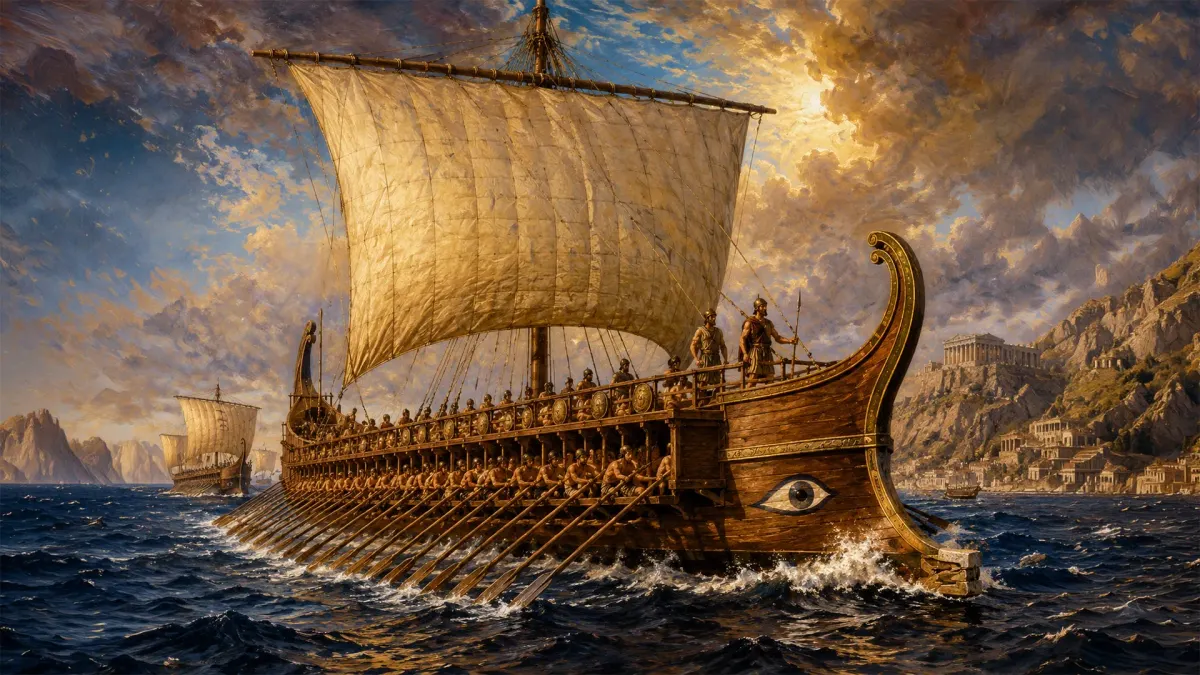
The Ship of Theseus is a thought experiment that explores the nature of identity through a simple scenario. Over time, a ship has each of its damaged parts replaced one by one. By the end of this process, every original component has been substituted with a new one.
The question then arises. Is it still the same ship after all its original components have been replaced?
The thought experiment deepens with a second layer. If someone were to collect all the discarded original parts and reassemble them into a ship, two ships would now exist.
One has remained in continuous use but contains none of its original material, while the other has been rebuilt from the original parts but lacks that continuity. Which one is truly the Ship of Theseus?
The Ship of Theseus in Real Life
- Our bodies continuously replace many of their cells throughout our lifetime, and our thoughts, beliefs, and practices shift and evolve over time. A few years from now, we may hold different convictions, carry different memories, and inhabit a body composed of different cells. So the question becomes, are we still the same person?
- Consider your favourite band or sports team. Over the years, every member you once cheered for may have left, and new faces have taken their place. At what point, if any, does it stop being the same band or team?
Now take it a step further. If those original members, the ones who defined the team, left and formed an entirely new team together, would that new team be your favourite? - A nation changes significantly over the centuries. Its borders may change, its traditions may evolve, its language may shift and its population will change as generations come and go.
A nation may even cease to exist for a time and later re-emerge. It may be colonized by another power, or it may establish colonies that later become independent.
If its language has changed, its traditions have evolved, and its people have been replaced over time, is it still the same nation?
One Layer Deeper
Imagine a future in which medicine advances to the point where every failing human organ can be replaced by a mechanical equivalent. You undergo each procedure gradually, one replacement at a time, remaining conscious and continuously aware throughout the process.
Eventually, every organ in your body has been replaced by an artificial one. Each step is small, and your sense of identity remains unbroken from beginning to end.
This continuity raises a philosophical question. If a person composed entirely of artificial components is still regarded as human because their identity persisted through gradual change, what does it truly mean to be human?
And if such a person remained human and sentient despite being built entirely from artificial parts, should we then apply the same logic to robots and artificial intelligence?
Conclusion
Identity may extend beyond the material world. We might just as well be our thoughts and actions, or nothing at all, or perhaps merely an illusion shaped by the Tinkerbell effect.
Keep the internet interesting